Case Studies
Each project below started with a real problem. Here's what it was, how we approached it, and what shipped.
Toyota / Lexus
My Role
Full product ownership across discovery and requirements gathering, PRDs and functional specs, Jira backlog management, sprint refinement, QA acceptance criteria, and UAT leadership.
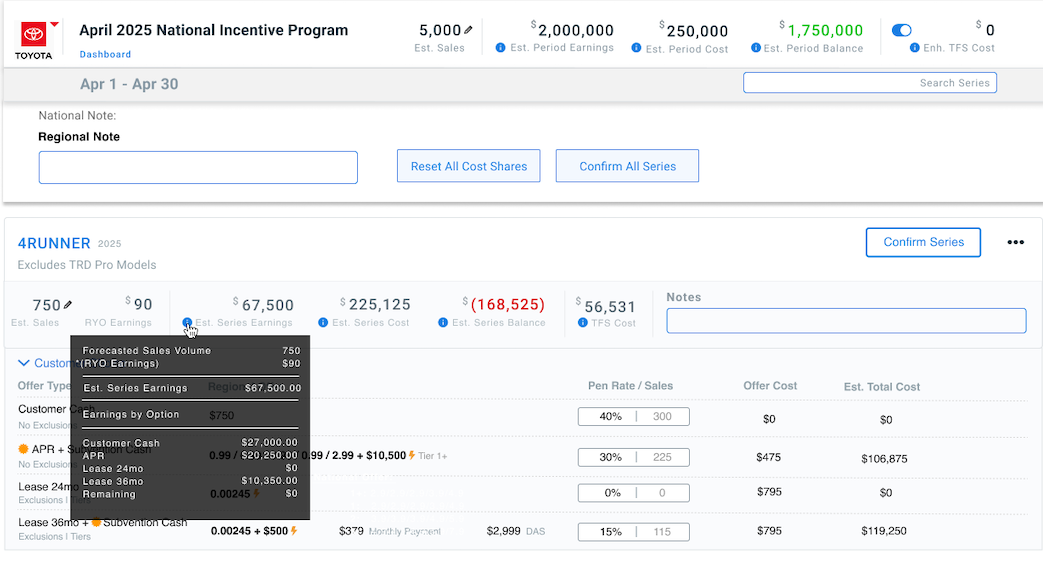
Toyota's regional incentives teams were managing monthly offer creation through shared spreadsheets passed between National and Regional teams. Data had to be pulled from multiple disconnected systems and entered manually at each step. The errors that crept into that process didn't stay contained — they surfaced as inaccurate payment estimations on Toyota.com and every consumer-facing property that depended on that data. For a brand where millions of purchase decisions hinge on accurate financing numbers, this was a meaningful business risk.
Discovery mapped the full offer lifecycle from National guidelines to Regional creation to downstream publication. Stakeholder sessions with National Incentives, Regional Marketing, finance, and platform teams quickly showed that the pain wasn't localized to any one team — it ran through the entire chain. Understanding those interdependencies shaped both the product architecture and what needed to ship in the first release versus what could follow.
We built OAT (Offers Admin Tool) as a centralized, workflow-driven platform that replaced manual data entry with a structured, validated approval process. National published monthly guidelines inside the tool. Regional teams reviewed, adjusted, and approved within the same interface. Validated data published automatically to downstream consumers — no re-entry required.
What launched as a regional workflow fix grew over six years into Toyota's central incentive infrastructure. Each iteration expanded scope: GST lease flows, TDA marketing screens, national budgeting, Toyota and Lexus certified used programs, Parts & Service offers, and a full microservices layer that decoupled data from presentation. The architecture evolved alongside the product, eventually moving toward modular GraphQL APIs to support the scale the platform had grown into.
OAT grew from a regional workflow fix into the backbone of Toyota's entire incentive data infrastructure — serving Toyota.com, Lexus.com, SmartPath, the Toyota Owners app, and dealer-facing tools. A targeted redesign of the regional office module, driven by years of user feedback, cut monthly incentive management time by 20%.
Fender
My Role
Full product ownership across discovery and requirements gathering, PRDs and functional specs, Jira backlog management, sprint refinement, QA acceptance criteria, and UAT leadership.
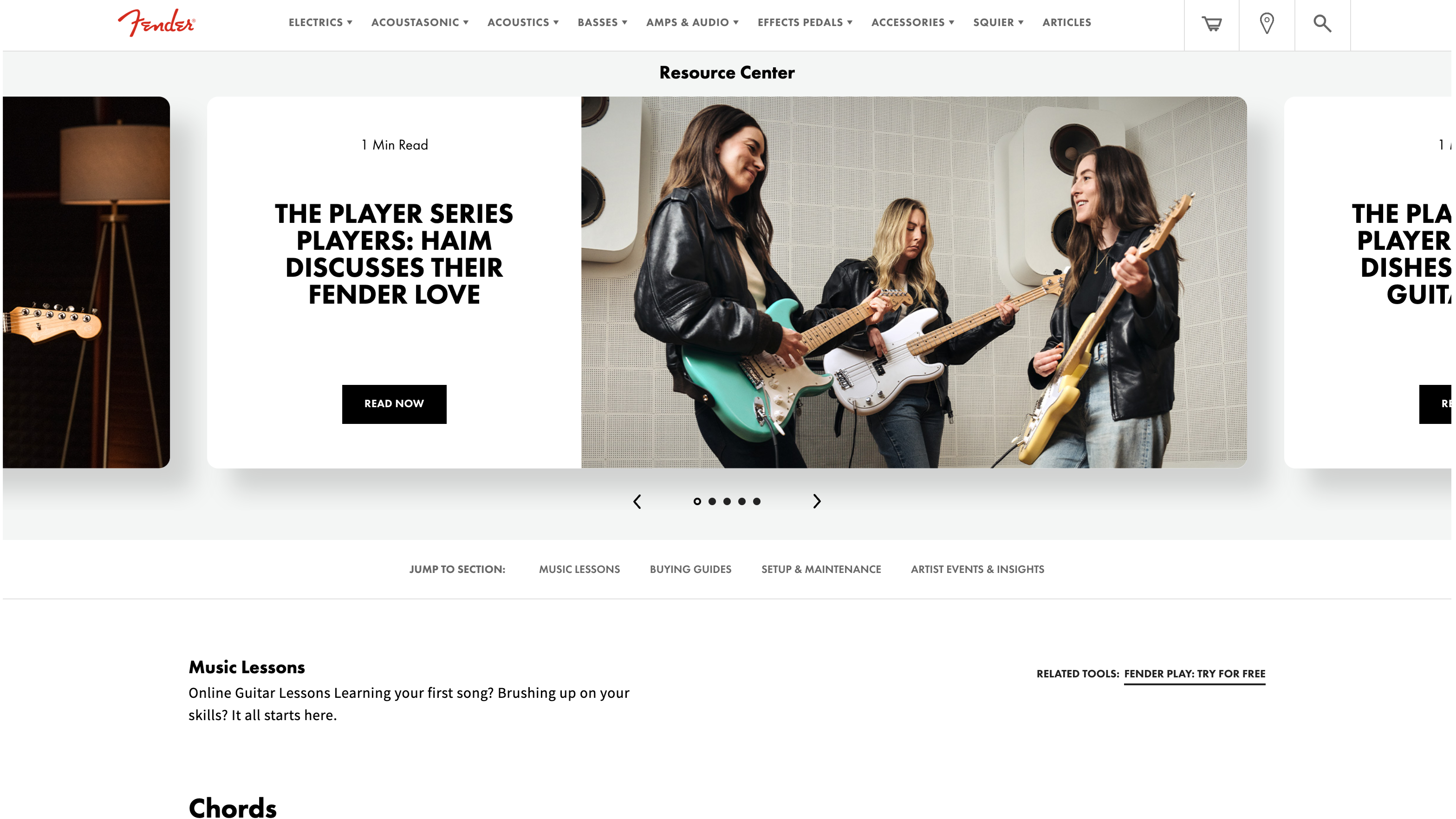
Fender's Resource Center was an 800-article platform that consistently drove organic traffic to Fender.com. But once visitors landed, the experience had nowhere to take them. Articles existed in isolation — no pathways to related content, no connection to Fender Play (their subscription learning platform), and no ability to surface product recommendations with live pricing. Content and e-commerce lived in separate systems that didn't communicate, making it nearly impossible to manage crosslinks, promotions, or product tags across close to 1,000 articles.
Discovery mapped the gap between traffic behavior and conversion. High-intent users were arriving — people searching for beginner guitar guides, gear comparisons, lesson content — and leaving without taking any next step. Two friction points stood out clearly: content wasn't connected laterally, and there was no monetization layer. Three objectives came out of discovery: make content navigable, connect content to e-commerce, and create a clear conversion path to Fender Play subscriptions.
We rebuilt the Resource Center around four distinct article templates — Homepage, Category Page, E-Commerce Article, and Lesson Article — each optimized for its role in the conversion funnel. The CMS was migrated to Contentful, and API integrations with Salesforce brought live product data into articles, so gear recommendations could display real-time pricing instead of generic mentions that went stale.
Lesson articles got persistent Fender Play CTAs in a sticky left rail. E-commerce articles surfaced recommended gear with a sticky right rail for constant visibility. The entire migration was done without taking the site offline — using incremental scripting to convert all 800+ articles while preserving search rankings and URL structure throughout.
The conversion pathway from articles to subscriptions was working from day one. Fender Play trial subscriptions increased 225% year over year. Total sessions grew 45%, with articles climbing to 10% of total Fender.com traffic. E-commerce orders from article pages increased 115%, with a 53% lift in associated revenue.
Samsung
My Role
Full product ownership across discovery and requirements gathering, PRDs and functional specs, Jira backlog management, sprint refinement, QA acceptance criteria, and UAT leadership.
Cheil, Samsung's Agency of Record, was running a growing college ambassador program entirely through email and spreadsheets. Task creation, content submission, review workflows, points tracking, and prize fulfillment were all handled manually. The process had worked at launch, but the program's growth had outpaced what manual management could support. The overhead was limiting how fast the program could scale and degrading the quality of campaign execution.
Mapping the existing workflow revealed three user groups with different needs: national admins managing the overall program, campus-level managers reviewing daily submissions, and student ambassadors completing tasks and earning rewards. Any solution had to work cleanly across all three. Discovery also surfaced something the spreadsheet process had been masking — students were motivated less by task completion and more by competition and public recognition. That insight shaped the gamification model that became central to the platform.
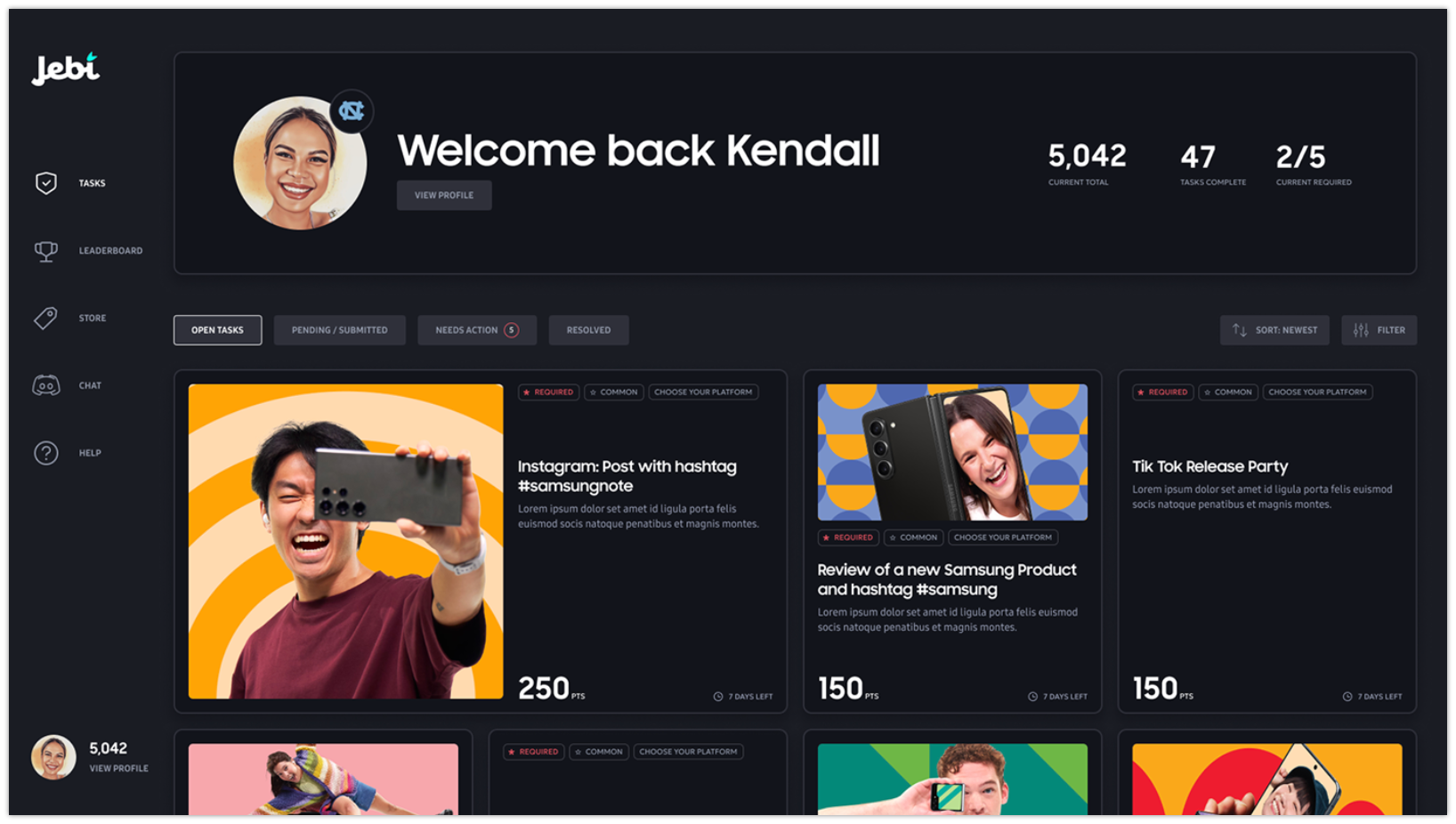
We designed and built Jebi, a custom full-stack platform that replaced the manual workflow with a structured, points-based campaign management system. Admins created tasks with defined point values and deadlines. Ambassadors completed tasks, earned points, and redeemed them in a virtual rewards store. Leaderboards ranked participation individually and by school, introducing the competitive dynamic that email chains never could deliver. The platform was architected to be client-agnostic, giving Cheil a foundation they could apply to other clients beyond Samsung.
In the initial 14-week pilot, 224 ambassadors generated 6,837 pieces of content. At peak, four managers were reviewing roughly 200 submissions per day. A program that started as a seasonal campaign became evergreen, with Cheil adopting Jebi as their standard platform for influencer campaign management.
Toyota
My Role
Full product ownership across discovery and requirements gathering, PRDs and functional specs, Jira backlog management, sprint refinement, QA acceptance criteria, and UAT leadership.
Toyota.com had several dealer locator experiences that had each been built independently, resulting in inconsistent design, separate codebases, and no shared data layer. As Toyota's digital strategy expanded — adding Certified Collision Centers, prioritizing EV charging infrastructure, and growing SmartPath — the fragmented map landscape meant every new requirement was a standalone rebuild. There was no foundation to build from, and no path toward consistency at scale.
Discovery started by mapping Toyota's full map roadmap rather than scoping only the immediate request. Conversations across TMNA, Saatchi & Saatchi LA, and platform teams confirmed that three distinct map types were already in planning with more likely to follow. The key insight was architectural: the right solution wasn't a better dealer map, it was a shared orchestration layer that any map type could consume. That reframe turned the project from a one-off build into a platform investment.
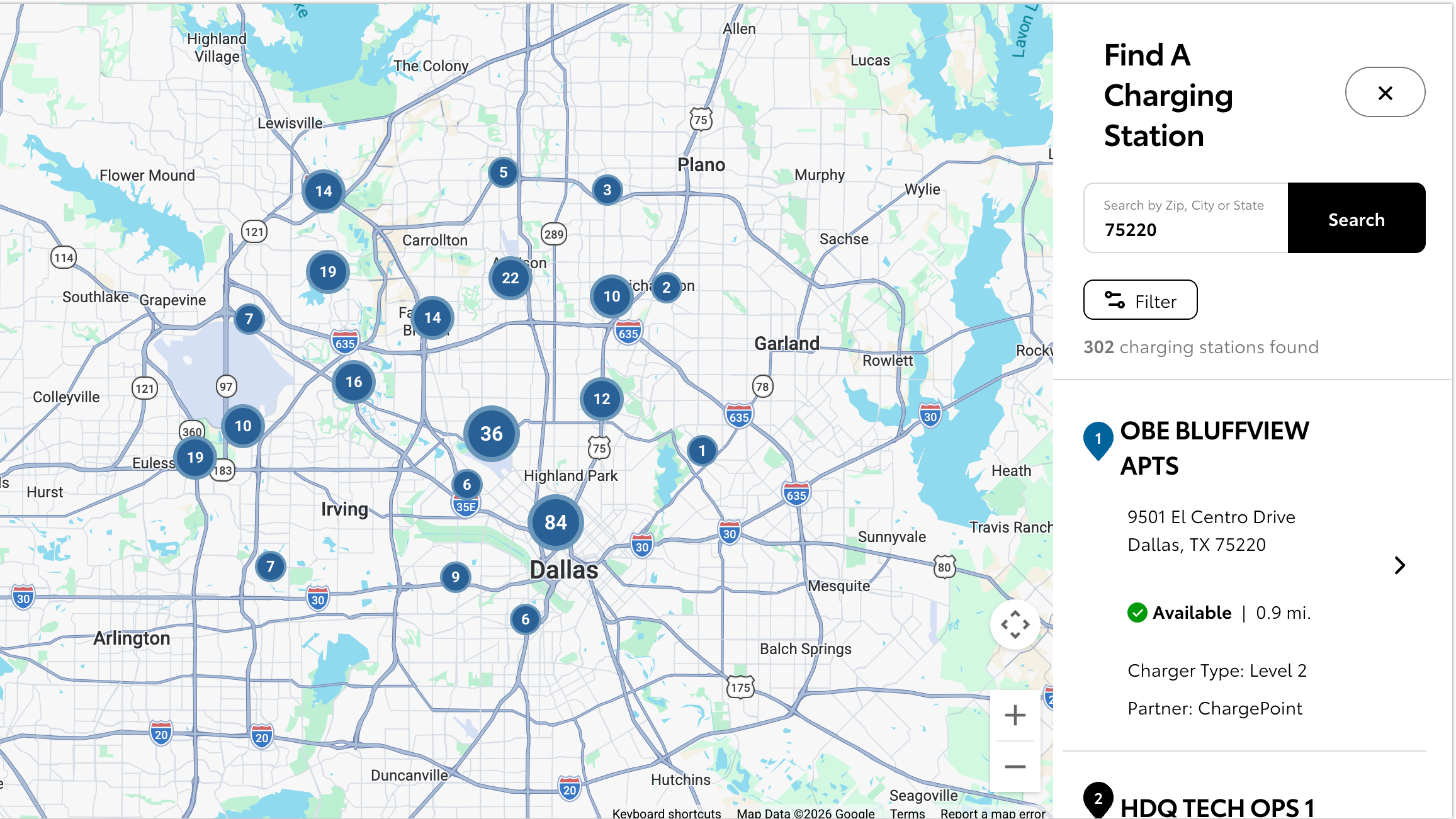
The solution was split into two layers. First, an AWS serverless orchestration layer built Active/Active across regions that aggregated data from 6+ APIs — including DIS for dealer and collision center data, OAT for local offers, Waldo for geolocation, and CT V1 for EV charging network data from EVGo and ChargePoint — into a single normalized source. Second, reusable AEM components in React/HTL that consumed the orchestration layer and rendered across Toyota.com properties.
The Dealer Map launched in November 2024. Certified Collision Centers followed in July 2025. The EV Charging Map launched in December 2025. Each one ran on the same underlying infrastructure.
Three distinct map experiences shipped in 13 months, all running on the same orchestration layer. Adding a new map type shifted from a development project to a configuration exercise. All three experiences are live on Toyota.com, serving millions of visitors across the Toyota and Lexus ecosystems.